Sourced lines at a glance
| Line | Credit | Source | Suits |
|---|
| "Brothers and Sisters, I bid you beware / Of giving your heart to a dog to tear." | Rudyard Kipling | "The Power of the Dog", in Actions and Reactions (1909) | A card to someone who already knows the poem |
| "Beauty without Vanity, Strength without Insolence, Courage without Ferocity, and all the Virtues of Man without his Vices." | John Cam Hobhouse | Boatswain's monument, Newstead Abbey (1808) | A big, gentle dog; a shelf card |
| "The one absolutely unselfish friend that a man can have in this selfish world..." | George Graham Vest | Closing argument in the Old Drum case, Warrensburg, Missouri (1870) | A loyal dog; a sympathy card |
| "Waiting at the Rainbow Bridge" (a short reference to the poem) | Edna Clyne-Rekhy | The Rainbow Bridge, written in 1959 after her dog Major died | Any pet, cats included; a garden stone |
| "If there are no dogs in Heaven, then when I die I want to go where they went." | Unknown (often credited to Will Rogers) | Earliest known post 1996 | A light line for a sympathy card or a framed shelf card |
Kipling's poem "The Power of the Dog"
Kipling's poem first appeared in his 1909 collection Actions and Reactions, according to the Kipling Society's reader's guide. Its first stanza is the part most often quoted:
"There is sorrow enough in the natural way / From men and women to fill our day; / And when we are certain of sorrow in store, / Why do we always arrange for more? / Brothers and Sisters, I bid you beware / Of giving your heart to a dog to tear."
The poem ends by asking "Should we give our hearts to a dog to tear?", so even its last line restates the warning. Read in full, the poem describes grief as the price of the bond, but no single line of it consoles on its own. Quote Kipling only to someone who already knows and loves the poem, and give the title so the whole thing is in view. For a friend in the first raw days, choose one of the lines below instead. The full text is on Poets.org.
The Boatswain epitaph at Newstead Abbey
Boatswain was Lord Byron's Newfoundland dog. He died of rabies in 1808, and Byron built him a monument at Newstead Abbey, his estate in Nottinghamshire. The inscription opens with the line that circulates as a Byron quote:
"Near this Spot are deposited the Remains of one who possessed Beauty without Vanity, Strength without Insolence, Courage without Ferocity, and all the Virtues of Man without his Vices."
Those prose lines were written by Byron's friend John Cam Hobhouse. Byron wrote the poem below them, "Epitaph to a Dog", as the Wikipedia article on the poem records. Credit the line to Hobhouse, or write "from Boatswain's monument, Newstead Abbey", which is accurate and easier for the reader to look up. It suits a large, calm dog, and it fits on a small printed card in a frame.
Senator Vest and Old Drum
On September 23, 1870, in the Johnson County courthouse in Warrensburg, Missouri, lawyer George Graham Vest gave the closing argument for Charles Burden, whose dog Old Drum had been shot. The U.S. Senate's history page keeps the speech. The Johnson County Historical Society tells the story of the case. As commonly printed, the speech opens "Gentlemen of the jury: The best friend a man has in the world may turn against him..." The famous passage follows, and these are its first and last lines:
"The one absolutely unselfish friend that a man can have in this selfish world..."
"...there by his graveside will the noble dog be found, his head between his paws, his eyes sad but open in alert watchfulness, faithful and true even to death."
The start of the passage works in a sympathy card for a dog who followed one person everywhere. The closing line is long, so it belongs on a card or in a photo book, where it has room.
The Rainbow Bridge, for a dog or a cat
The Rainbow Bridge describes pets waiting in a meadow until their people arrive, then crossing the bridge together. For years it was printed as "author unknown", and Oregon grief counselor Paul C. Dahm published a version in 1981 and claimed it. In 2023 National Geographic reported that Edna Clyne-Rekhy, a Scottish artist, wrote it in 1959, the day after her Labrador Major died.
Because the poem names no species, it is the usual choice for cat memorial quotes as well as dog loss quotes. A short reference does the work: "Waiting at the Rainbow Bridge" under the pet's name and dates. If you print the full poem, credit Edna Clyne-Rekhy; our guide to the Rainbow Bridge poem summarizes it and shows how to print it.
The Will Rogers line
"If there are no dogs in Heaven, then when I die I want to go where they went."
This line is shared everywhere with Will Rogers' name on it. The etymologist Barry Popik traced it to a newsgroup post of March 15, 1996, found it marked "unknown" in 1999, and found Rogers' name attached only from 2002. Rogers died in 1935, and Popik found no evidence that he said it. Use the line with "Unknown" as the credit, or with no credit.
Short lines for a sympathy card
These four speak to the death itself, and each comes from a source you can look up.
- "The one best place to bury a good dog is in the heart of its master." Ben Hur Lampman, closing line of "Where to Bury a Dog", an editorial in The Oregonian on September 11, 1925, as quoted by the Oregon Encyclopedia. Some reprints read "his master".
- "...not all the power of death can keep my spirit from wagging a grateful tail." Eugene O'Neill, "The Last Will and Testament of an Extremely Distinguished Dog", written in December 1940 in the voice of his Dalmatian Blemie, as quoted by the National Park Service.
- "To mark a Friend's remains these stones arise; / I never knew but one, and here he lies." Lord Byron, the closing lines of "Epitaph to a Dog" on Boatswain's monument (1808), per the Wikipedia article on the poem.
- "I was rather more grieved than philosophy admits of & he has made a sort of blank which nothing will fill up for a long while." Sir Walter Scott, letter to Richard Heber, 10 March 1809, after his dog Camp died, as quoted by the University of Edinburgh's Walter Scott collection.
Where the quote goes when the portrait has no text
Portraits are printed without text, so the quote needs a place of its own beside the portrait. Pick the place by the length of the line.
- Inside the sympathy card. Any line fits here, including the full Vest closing. Write the dog's name above the quote and one memory of your own below it.
- A small framed card on the memorial shelf. Print the line, the dog's name and the years, and stand it next to the portrait and the urn. The 8 x 10 in portrait fits a shelf; the size and frame guide compares it with the 12 x 16 in size for a wall.
- A garden stone. Keep it to a name, the years and a few words, such as "Waiting at the Rainbow Bridge".
- The first page of a photo book. Long poems such as Kipling's fit here in full.
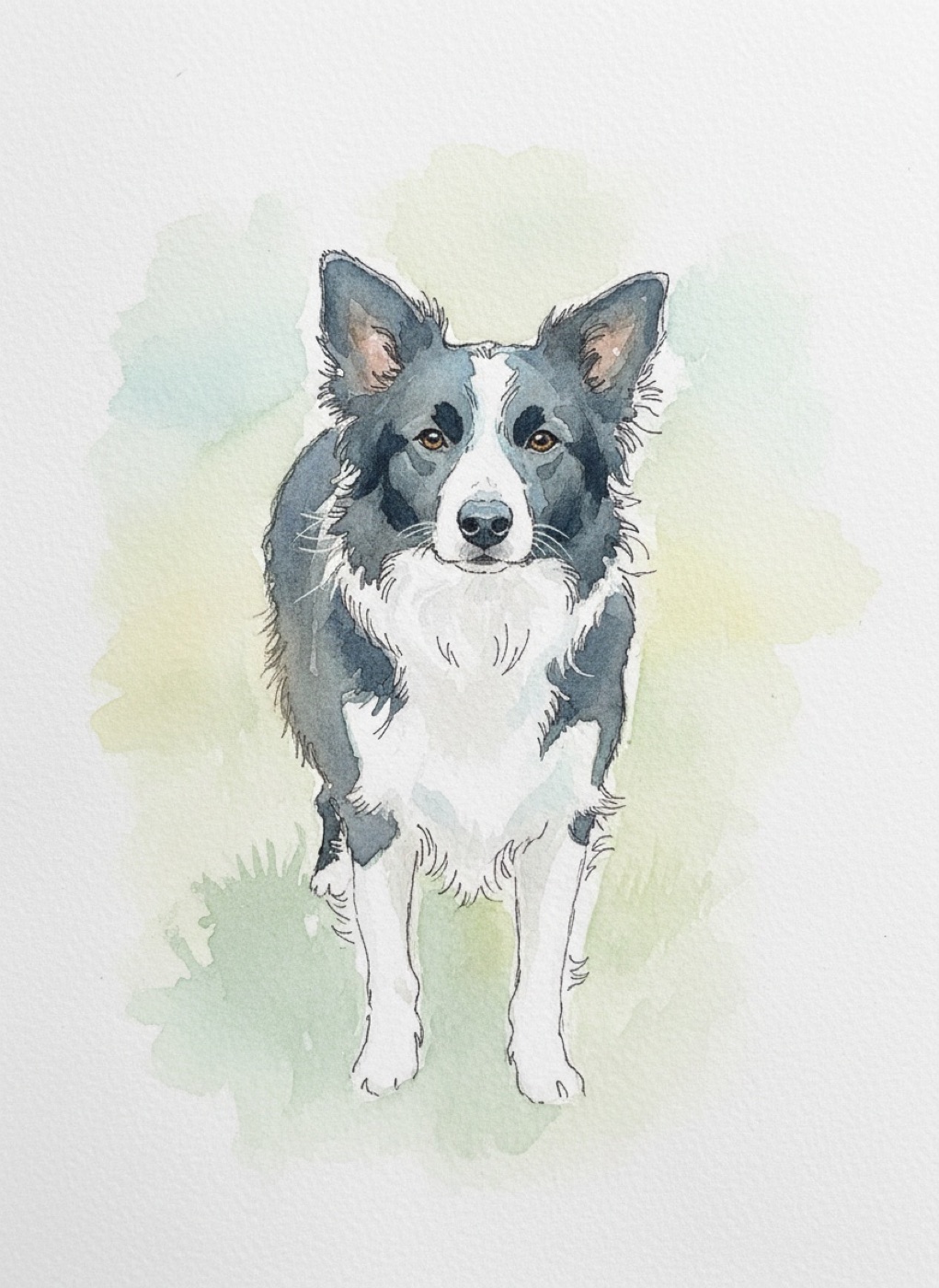 Style sample: Pepper, a border collie, in the Watercolor style
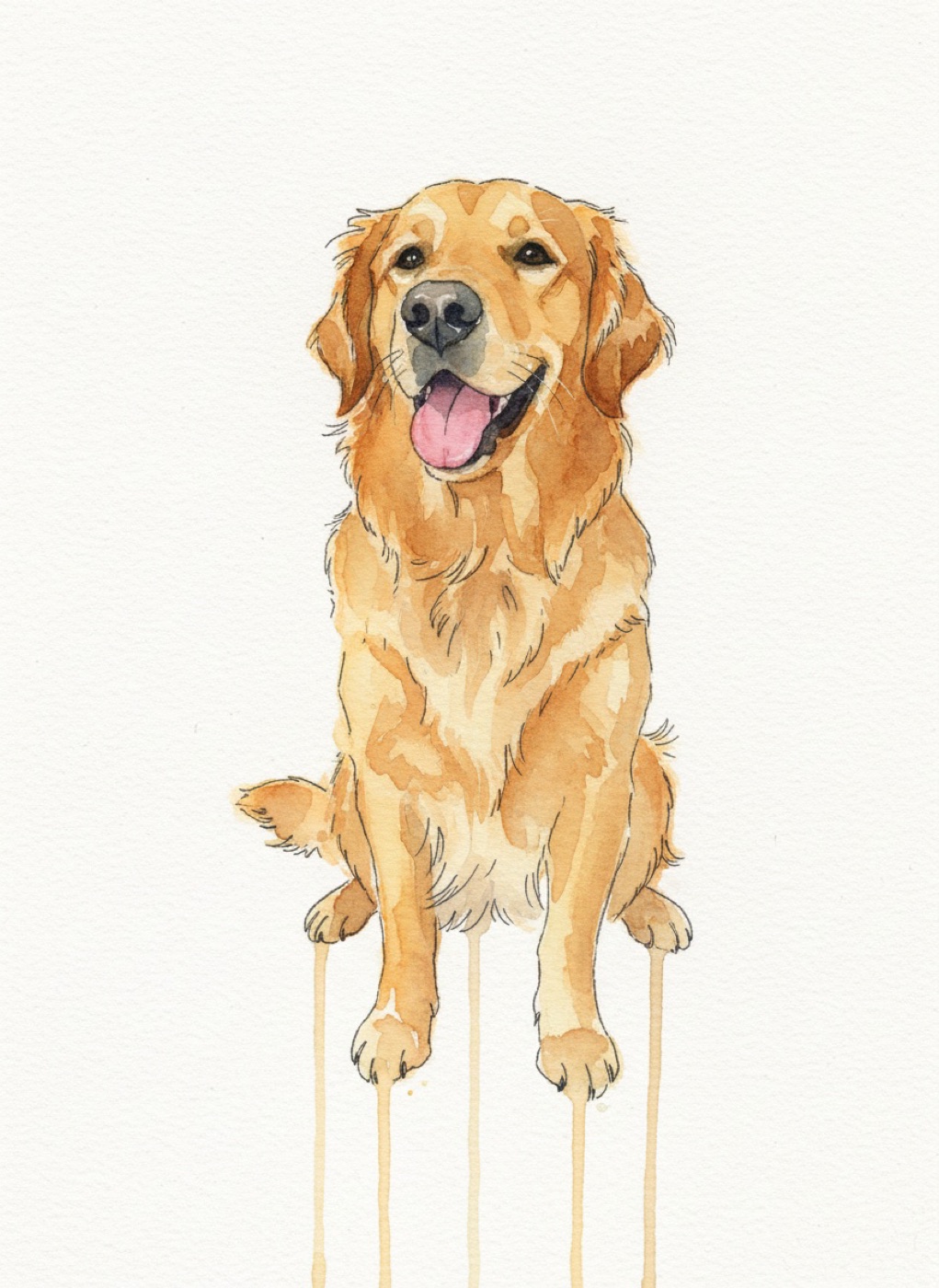 Style sample: Goldie, a golden retriever, in the Watercolor style
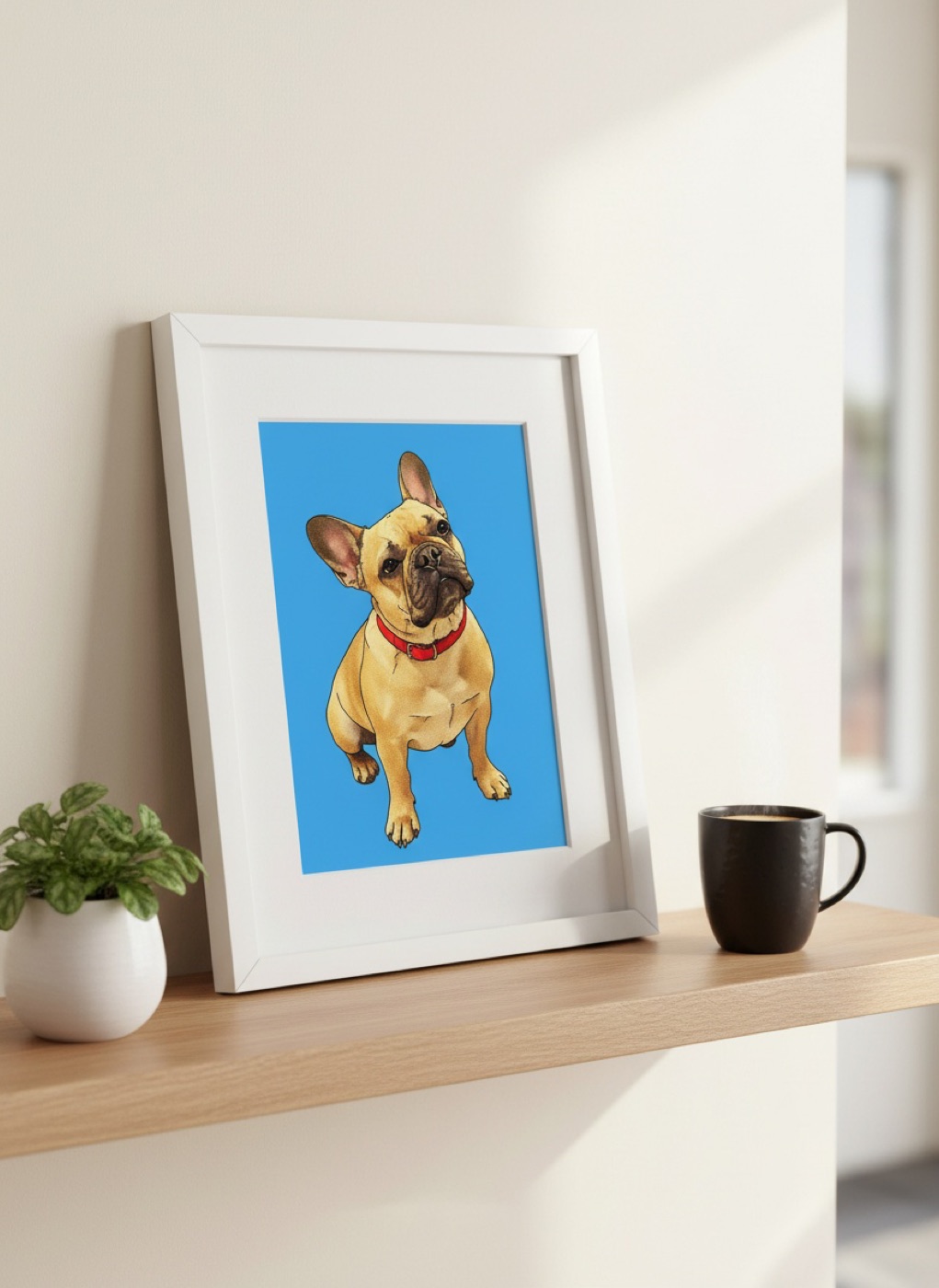 A framed portrait of Biscuit the French bulldog on a shelf
Each portrait arrives framed with a one inch white mat, ready to hang, and you see the finished portrait on screen before you pay. The memorial portrait guide covers choosing a photo when there are only a few, and the Watercolor style page shows the softest of the styles on sample dogs.
Mistakes to avoid with dog memorial quotes
- Carving a misattributed name. A wrong credit on a stone stays there. Check the source first, using the table above.
- Quoting Kipling in a fresh sympathy card. The poem opens and closes on the warning, so a line lifted from it can read as "you should not have loved the dog". Keep Kipling for someone who already knows the poem.
- Putting a long quote on a small object. A Vest passage on a garden stone becomes small print nobody can read from standing height.
- Leaving out the dog's name. Popular quotes appear on many cards. The name and one detail make it about this dog.
For more ways to mark the loss, from paw prints to a planted shrub, see our pet memorial ideas.
Updated November 13, 2026